Lisbon's Monument to the Discoveries, Framed by Belém Marina
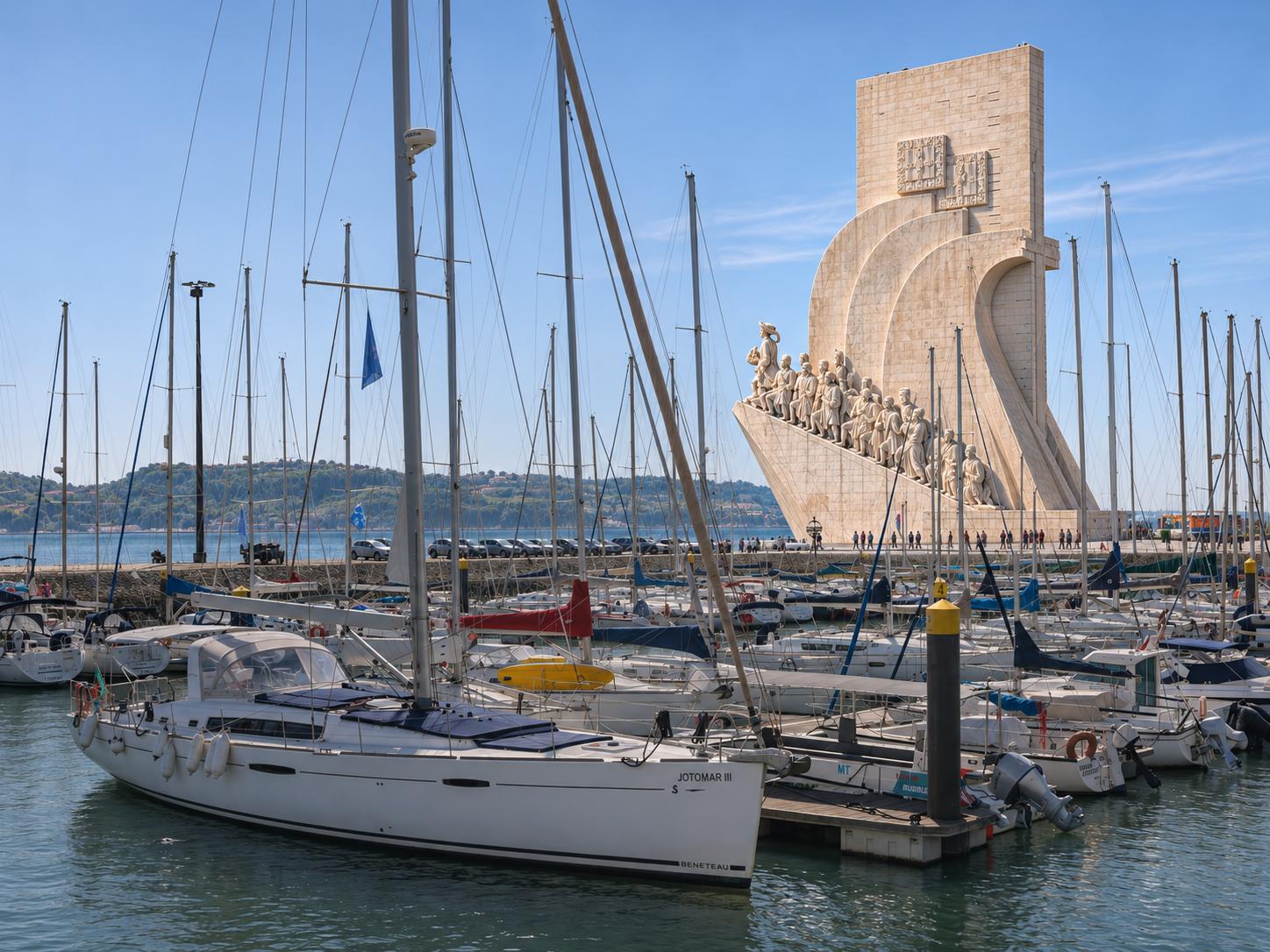
At first glance, the eye is drawn to the sailing yachts. They are moored close together in the sheltered water of Belém marina, with tall masts rising in almost every direction and rigging lines turning the sky into an elaborate mesh. Then, beyond the boats, a pale stone structure emerges above the waterfront. It is the Padrão dos Descobrimentos, Lisbon's Monument to the Discoveries, and from this angle it looks less like a detached historic landmark than another enormous vessel waiting at the edge of the Tagus.
That is the charm of this particular viewpoint. The marina is busy with the details of present-day sailing: white hulls, dark cockpit covers, fenders hanging against the boats, a yellow dinghy, wooden pontoons and the occasional flag caught by the breeze. Across the road and quay, the monument rises above a line of cars and tiny pedestrians. Its carved procession of figures follows the sloping edge of a stylized ship's prow, pointing outward toward the river. The contrast is wonderful. Modern pleasure craft occupy the foreground, while a much larger stone ship commemorates a time when departures from this waterfront could change the course of history.
Photograph hosted by VirtualTravelGuide.com.
It would be easy to photograph the monument alone from its immediate surroundings, eliminating the boats and arranging the figures against a clean sky. That is the standard postcard view, and for good reason. Yet the marina adds something a postcard can miss: context. The vertical masts echo the monument's own sail-like geometry, and the hulls in the foreground remind us that Lisbon is still a city with an active relationship to its river. Even the clutter of ropes and rigging helps tell the story. Here, the monument is not isolated from contemporary life; it is part of the waterfront people use every day.
The structure's history is more recent than its subject might suggest. Designed by architect Cottinelli Telmo with sculptor Leopoldo de Almeida, the original Monument to the Discoveries was built as a temporary work for the 1940 Portuguese World Exhibition. The present monument was reconstructed in 1960 to mark the 500th anniversary of the death of Henry the Navigator. Henry stands at the prow, followed by 32 figures associated with Portuguese maritime expansion and its cultural history. The carved company includes navigators, cartographers, chroniclers and other historical figures. The monument gives that era a striking visual form, although the history it commemorates encompasses exploration and exchange as well as conquest and colonial rule. The monument's official history is a useful starting point before a visit.
Belém is particularly rewarding because the distance between grand history and ordinary city life is so short. You can stand near the marina watching boats shift gently against their moorings, follow the waterfront toward the monument, and then turn inland toward Jerónimos Monastery and the Maritime Museum. Each stop tells a different part of Portugal's seafaring story. The monument's sculptural composition works best at close range, where the individual figures and their gestures become easier to distinguish, but the distant view across the marina reveals its shape as a whole.
For visitors planning photographs, this is a place to try more than one perspective. From the quay by the Doca de Belém, let a few masts frame the monument rather than trying to keep every rope out of the image. Move until its pale stone surfaces separate from the busier details of the harbor, and watch how the light catches the procession of figures. On a hazy afternoon, the limestone can lose definition against a bright sky; a slightly different angle or a change in exposure can make the sculptural edge easier to see. The boats are not a distraction unless you treat them as one. They are the foreground that makes this view distinctive.
The marina itself is not just scenery. The Port of Lisbon's Doca de Belém is a working recreational dock, with pontoons and services for visiting and resident boats. That makes it a lively counterpoint to the stone monument just beyond it. Anyone who wants to go inside the monument can check official opening times and access information before setting out; Belém station and tram 15 are among the nearby transport options.
For a longer walk, combine this stop with Belém Tower and the busy Lisbon waterfront or the maritime architecture around the museum. But do not hurry away from the marina once you have photographed the famous monument. Spend a little time watching the masts, the changing light and the small movements of the boats. In that layered view, Lisbon's maritime past and present share the same stretch of water, and the great stone ship finally finds its setting.