Palermo's Politeama, Where Monumental Architecture Meets Everyday Sicilian Life
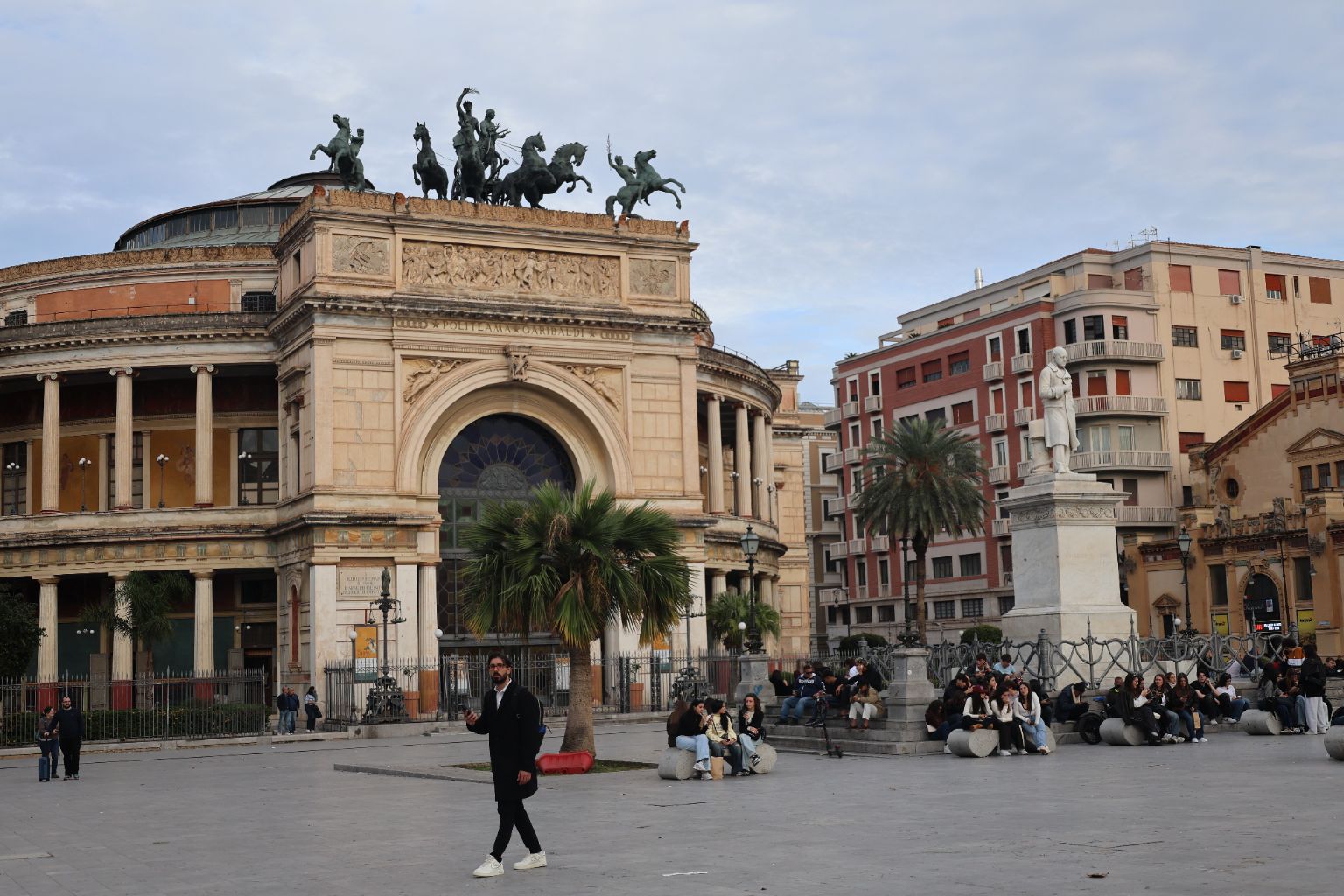
Palermo does not always make you choose between a grand monument and an ordinary street scene. In Piazza Ruggero Settimo, the nineteenth-century Teatro Politeama Garibaldi supplies an almost operatic backdrop to a square that belongs just as much to the people passing through it. Its monumental triumphal arch, sweeping colonnades and bronze horses stand above a broad paved space where young people meet, friends talk and pedestrians cross in every direction. In this photograph, taken beneath a soft November sky, the contrast is particularly striking.
The roofline draws the eye first. Bronze horses rear and surge forward above the entrance, their silhouettes standing clear against the clouds. This is the Triumph of Apollo and Euterpe, the sculptural composition by Mario Rutelli, accompanied by equestrian figures by Benedetto Civiletti. Below them, the elaborate carved frieze and great arch reveal the theatre's fascination with classical spectacle. Even the round window inside the arch contributes to the feeling that the entire building is part of a stage set. The Politeama was designed by Giuseppe Damiani Almeyda and inaugurated in 1874; today it is associated with the Orchestra Sinfonica Siciliana.
Original photograph hosted by MediaInstances.com.
Yet the human details are what give this picture its character. At the right, the monument to Ruggero Settimo rises above groups sitting around its base, while others gather on low stone seats. A tall palm tree interrupts the geometry of the theatre, another stands beside the modern apartment buildings, and a man in a black coat and white shoes strides across the open foreground while looking at his phone. Behind the statue, red and cream façades form a very different architectural layer from the theatre's old stone. The whole scene feels like a meeting of several Palermos, all taking place at once.
Locals commonly call the adjoining Piazza Ruggero Settimo and Piazza Castelnuovo area Piazza Politeama. It is part of the city's everyday geography rather than a ceremonial space visited only by tourists. People come to meet friends, take a break, watch the activity around them or simply pass between the centre and the streets leading toward Via della Libertà. You can admire the roof sculptures and linger over the details of the building, then turn around to find a lively contemporary city unfolding in front of them.
An overcast day has its advantages for photography here. Instead of direct sunlight flattening one side of the square into brightness and leaving another in deep shadow, the diffused light allows the stone carving, bronze sculpture, palm fronds and modern façades to retain their detail. The broad foreground gives the eye somewhere to rest before climbing toward the restless horses above the roofline. Palermo is famous for its markets, churches and narrow lanes, but its open civic spaces deserve an equal place in the traveler's itinerary.
Piazza Politeama is easy to enjoy without a schedule. Spend a few minutes studying the entrance, look at the bronze quadriga from different angles, and then linger long enough to see how the square is actually used. What remains in the memory is not only the scale of the monument but the ease with which modern Sicilian life carries on beneath it. That, perhaps, is the most convincing kind of urban theatre.