Belém Tower and the Busy Lisbon Waterfront
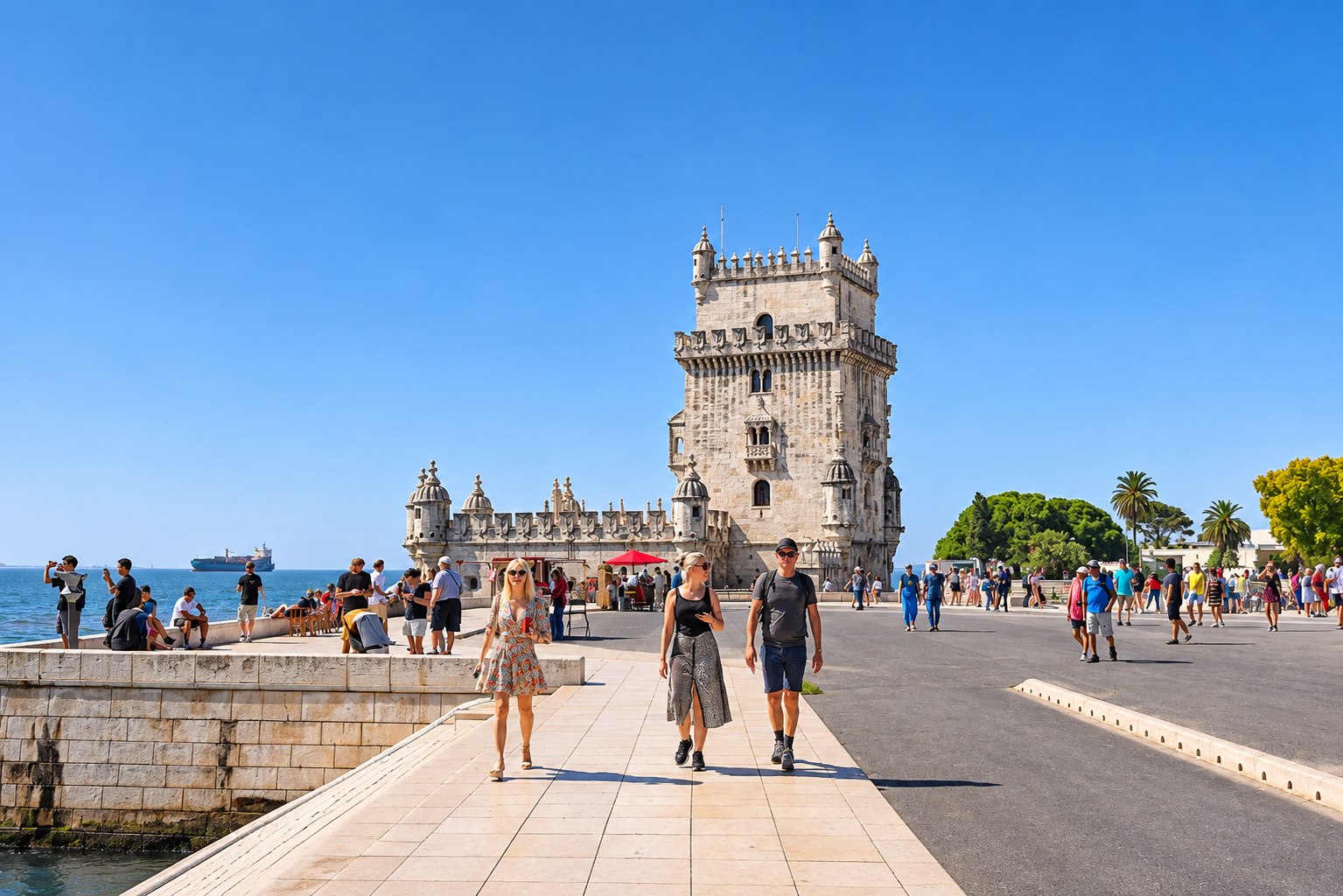
The Tower of Belém is nearly five centuries old, yet the scene around it belongs completely to modern Lisbon. A crowd spreads across the broad riverside promenade. People take photographs, look toward the Tagus, stop at small stalls and walk past the fortress without quite breaking stride. A cargo ship moves across the background. The old defensive tower, once built to watch who entered the city by water, now watches visitors arrive on foot.
The most interesting part of this view is the contrast in scale. Three people walk toward the camera along the sunlit paving, while other visitors gather beside the low stone seawall. Above them stands a compact fortress with an astonishing amount of detail: corner turrets, ribbed domes, carved battlements and narrow windows. The sky takes up almost half the scene, making the pale limestone seem even more solid. It is a busy photograph, and that's exactly what a visit here often feels like.
Photograph hosted by Pxef.com.
Five Centuries Beside the Tagus
Built in the early sixteenth century under King Manuel I, the tower was part of the defenses at the entrance to Lisbon's harbor. Its architect, Francisco de Arruda, combined a practical riverside fortification with the intricate Portuguese Manueline style. Maritime motifs and the crosses of the Order of Christ connect the stonework to the age when Portuguese vessels sailed out toward Africa, Asia and the Atlantic. UNESCO included the tower and nearby Jerónimos Monastery on its World Heritage List in 1983.
Today the building has a rather different job. It anchors a public waterfront that draws visitors regardless of whether they have tickets to enter. That distinction matters. You can spend an enjoyable hour here just examining the outer walls, moving between different viewpoints and watching the river traffic. The fortress was built to control access, but much of its appeal now comes from the open space around it.
The Best View Is Not Always the Emptiest
Travel photographs of famous monuments often try to eliminate everyone else. At Belém that can mean waiting for a clear foreground that may never arrive, especially on a bright day. There is another approach: leave the people in the frame. The walkers give the tower scale, the scattered groups show how the promenade is used, and the distant ship provides a small reminder that the Tagus remains a working waterway.
For a more architectural photograph, move along the riverbank and look for a position that separates the tower from the surrounding visitors. In strong midday light, pale stone and blue sky create a crisp outline, though the sun can flatten the details carved into the walls. Lower light later in the day brings out more texture. If you want both the tower and the scene around it, a wider composition tells a better story than a tight crop of its highest turrets.
Make the Waterfront Part of the Visit
Belém is best explored as a walk rather than a single stop for a photograph. Follow the riverside path toward the Monument to the Discoveries, then turn inland for Jerónimos Monastery and the streets around it. You get different views of Lisbon's maritime past without spending the whole visit in a queue. The wide promenade also gives children, walkers and photographers room to move even when the central tourist areas feel crowded.
Allow time simply to stand beside the Tagus. Look at the stonework, watch the ships and notice how a military building has become the backdrop to an ordinary sunny afternoon. The crowds can be inconvenient, yes, but they are part of the living city. Belém Tower looks especially interesting when the photograph lets both centuries share the same frame.
For interior access and ticket advice, see our guide to Belém Tower's reopening in 2026. For another view of the monument, read Belém Tower, Where Stone, River, and Light Converge.