Porto Ribeira Waterfront, Houses and Balconies Above the Douro
There is a reason Porto's Ribeira waterfront makes people stop walking and look up. Above the stone embankment, one house seems to rise out of another, with tall windows, narrow balconies and steep roofs fitting together along the river. Some walls are pale cream or yellow, others deep red or charcoal grey. Roof additions sit above much older-looking stone facades, and the whole row has the crowded, layered character of a neighbourhood that has been altered over generations rather than designed in one stroke.
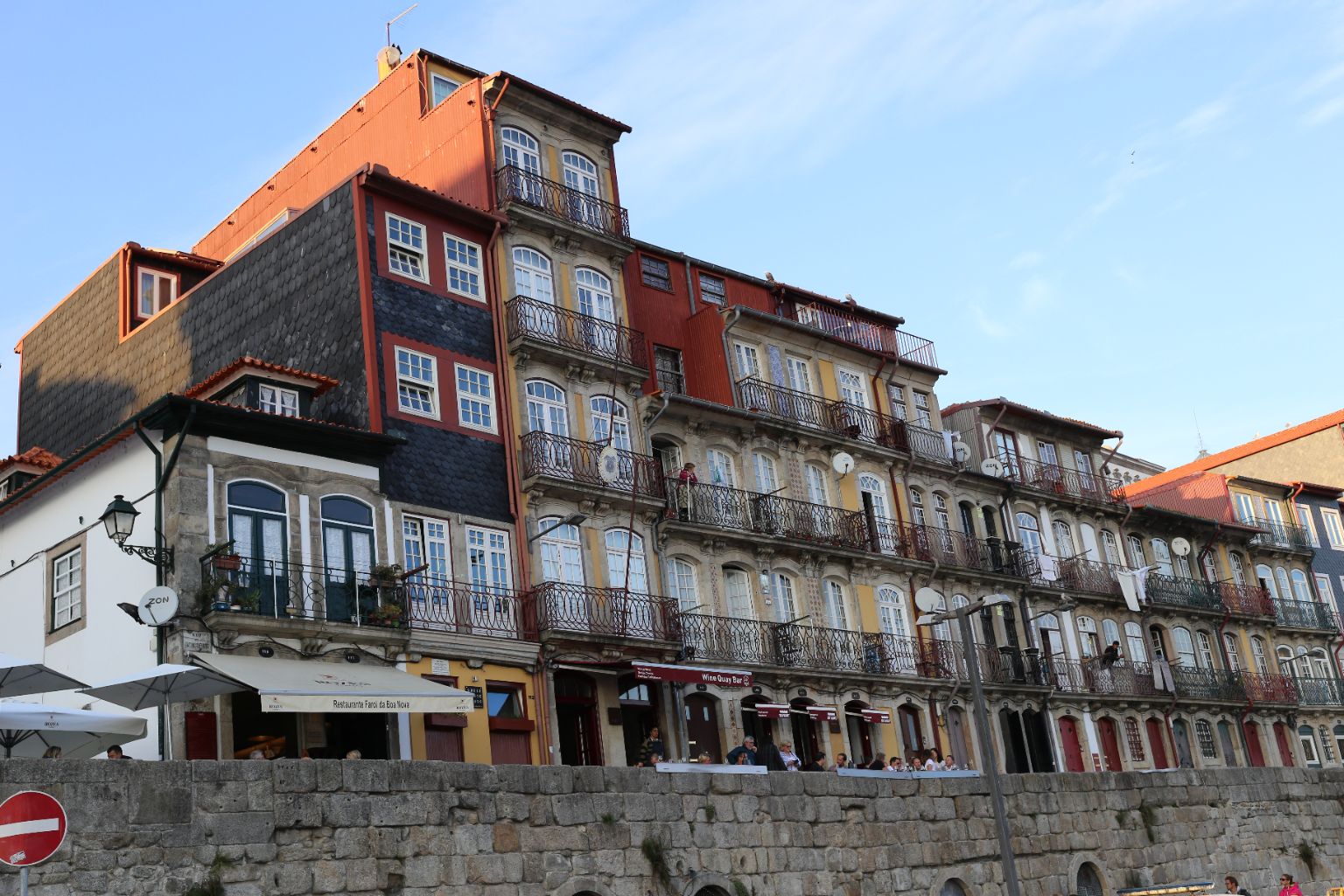
The photograph shows that character particularly well. Its left side is dominated by a high slate-clad roof and a red upper storey, while the middle of the frame is crowded with delicate wrought-iron balcony railings, pale window frames, decorative stone surrounds and dormer windows. A little farther along, red metal roofing gives way to yellow and grey facades. Satellite dishes and television antennas interrupt the historical picture, as they do in a real city. At street level, white café umbrellas shade tables, people sit facing the river, and the Wine Quay Bar sign appears beneath the balconies. A heavy granite embankment wall runs across the foreground, anchoring the delicate facades above it.
Photograph hosted by TravelMktg.com.
This is Muro dos Bacalhoeiros, along the northern bank of the Douro in Porto, Portugal. The Wine Quay Bar at numbers 111 and 112 provides a useful landmark for finding this stretch. Ribeira is part of Porto's historic centre, which UNESCO inscribed on the World Heritage List in 1996 along with the Luiz I Bridge and the Monastery of Serra do Pilar. Its appeal is more immediate than any designation, though. The working details of daily life remain visible alongside the old architecture, and the cafés have made the waterfront a place to linger instead of merely pass through.
To see the neighbourhood at its best, start around Praça da Ribeira and continue on foot beside the water, taking time to look back at the buildings from different angles. The riverside is easy to follow, but the streets climbing away from it are narrow and steep. A detour uphill reveals how quickly Porto changes scale: the wide Douro disappears behind houses, stairs rise between stone walls, and the streets begin to feel far older and more intimate than the terrace-lined quay. Comfortable shoes matter more here than a tightly scheduled itinerary.
The photograph offers a useful lesson for anyone carrying a camera. A distant panorama from Vila Nova de Gaia shows how Porto climbs the hillside, but a closer view from the riverbank reveals details that disappear in the skyline: curved ironwork, mismatched shutter heights, drainpipes, roof tiles and the strange geometry of upper floors built at different depths. A slightly upward composition gives the balconies room to stack, while the stone wall at the bottom keeps the picture connected to the waterfront. In bright light, watch the contrast between illuminated roofs and dark windows; softer light can give more detail to both.
This part of the city is popular, particularly around lunch and sunset, and its river-facing tables come with a premium location. There is no need to commit to a long restaurant stop to enjoy the setting. Walk the quay first, examine the menus where you might want to sit, and make time for the smaller streets behind the promenade. The narrow balconies and crowded rooftops tell as much of Porto's story as the grand monuments do. Even the television dishes, which a postcard photographer might want removed, remind visitors that these are still buildings in use.
For a wider perspective, cross the Douro to the Gaia side and compare the view with this close-up of Ribeira. The houses that fill the photograph become a colourful ribbon beneath Porto's skyline, with the bridge rising beside them. Our guide to Porto from the Gaia side explains where to stand for that panorama. The two views belong together: one shows the city as a whole, the other lets you notice the windows, balconies and everyday life that give the waterfront its personality.