Mortadella, the Unsung Modest Hero of Italian Cuisine
There are Italian foods that arrive at the table demanding applause. A towering plate of pasta, a glossy burrata, a pizza emerging from a wood-fired oven. Mortadella rarely makes such an entrance. It is pink, round, familiar, and almost disarmingly modest. Yet this enormous, delicately perfumed sausage from Bologna deserves a place among the great achievements of Italian cuisine.
In a delicatessen display, the spectacle is surprisingly charming. Whole, copper-pink mortadella loaves sit bound in string on wooden stands, while a freshly cut face reveals a pale rosy interior scattered with small white pieces of fat. In the photograph here, the giant rounds share the counter with a pink flamingo and tiny toy ponies, a playful setting for a food whose history and craftsmanship are considerably more serious than its cheerful appearance suggests.
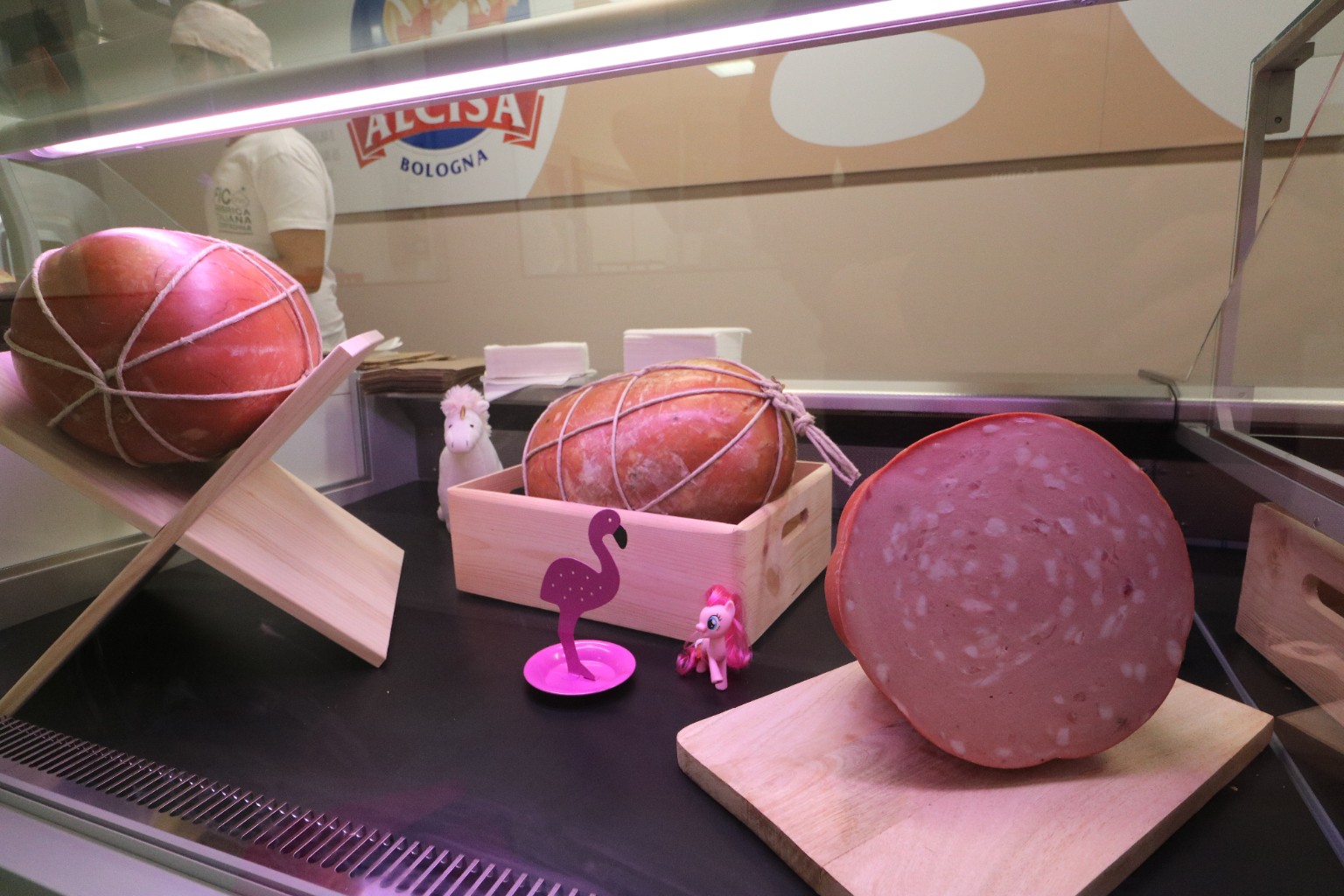
Mortadella's home is Bologna, a city that has never needed to choose between intellectual life and the pleasures of the table. Its food culture is generous, practical, and confident. The city's famous sausage belongs to that tradition: an everyday luxury that needs neither elaborate garnish nor expensive presentation to justify itself.
Authentic Mortadella Bologna PGI is made from finely minced pork mixed with cubes of pork fat, seasoned and slowly cooked. The pale flecks in each slice are not an accident or a cheap filler; they are essential to the characteristic tenderness and richness. Depending on the producer, the seasoning can include pepper, pistachios, and other aromatics. The result should be gentle rather than aggressively smoky or salty, with a smooth texture and a subtle, almost sweet fragrance.
Its reputation has suffered somewhat from imitation. In many countries, the word 'bologna' evokes inexpensive, uniform sandwich meat. That association can obscure the difference between industrial lunch meat and carefully made Italian mortadella. A good slice is soft but not mushy, richly flavored without being heavy, and satisfying even when eaten entirely on its own.
The best way to discover it may also be the simplest. Ask for thin slices at a salumeria and tuck them into fresh bread, perhaps a warm piece of focaccia or a crisp rosetta. Let the mortadella do the work. A little cheese can be welcome, but piling on strong sauces misses the point. In Bologna, mortadella also appears in more elaborate preparations, including fillings and contemporary restaurant dishes, though its humble sandwich form remains hard to beat.
It is also an unusually democratic pleasure. You can encounter mortadella in a market stall, a neighborhood grocery, a train-station sandwich, or a restaurant reinterpreting regional classics. Its appeal crosses the boundaries between street food and gastronomy. That is one of the quiet strengths of Italian cuisine: the same ingredient can be ordinary and exceptional, depending on how carefully it is made and how attentively it is eaten.
For travelers, Bologna offers a chance to taste mortadella in context. Browse the city's food shops, look at the enormous sausages hanging or resting behind glass, and order a modest portion rather than rushing immediately to a grand meal. Ask where it was made. Notice its aroma, the fine grain of the meat, and the contrast between the pink base and the ivory-white fat. These details tell a better story than any elaborate menu description.
Mortadella does not need to be reinvented as a luxury product to earn respect. It has already spent generations doing what excellent regional food does best: making an ordinary lunch feel like a small celebration. Italy has louder culinary ambassadors, certainly. But few are more lovable than Bologna's quiet, oversized, pink hero.
Photograph hosted by Peppers.org.