Catania's Piazza del Duomo: The Lava Elephant, Sant'Agata and the Fish Market Next Door
Catania keeps its mascot in the middle of its main square. A small elephant carved from black lava stands on a white marble plinth, grinning slightly, carrying an Egyptian obelisk on its back. The locals call it u Liotru, and they've been rubbing it, climbing it and meeting under it for centuries.
The elephant stands at the heart of the Piazza del Duomo, the square that Catania rebuilt after the earthquake of 1693 flattened most of the city. The architect Giovanni Battista Vaccarini designed the fountain in 1736, putting together an ancient lava elephant of uncertain origin and an obelisk on its back, and the square around it was rebuilt in the same years in a baroque of grey lava and white limestone.
The photo below is the square on a June morning. The obelisk rises against a blue sky streaked with cloud, the elephant on its fountain below, people sitting on the steps of the plinth in the shade, the town hall on the left and a church dome behind.
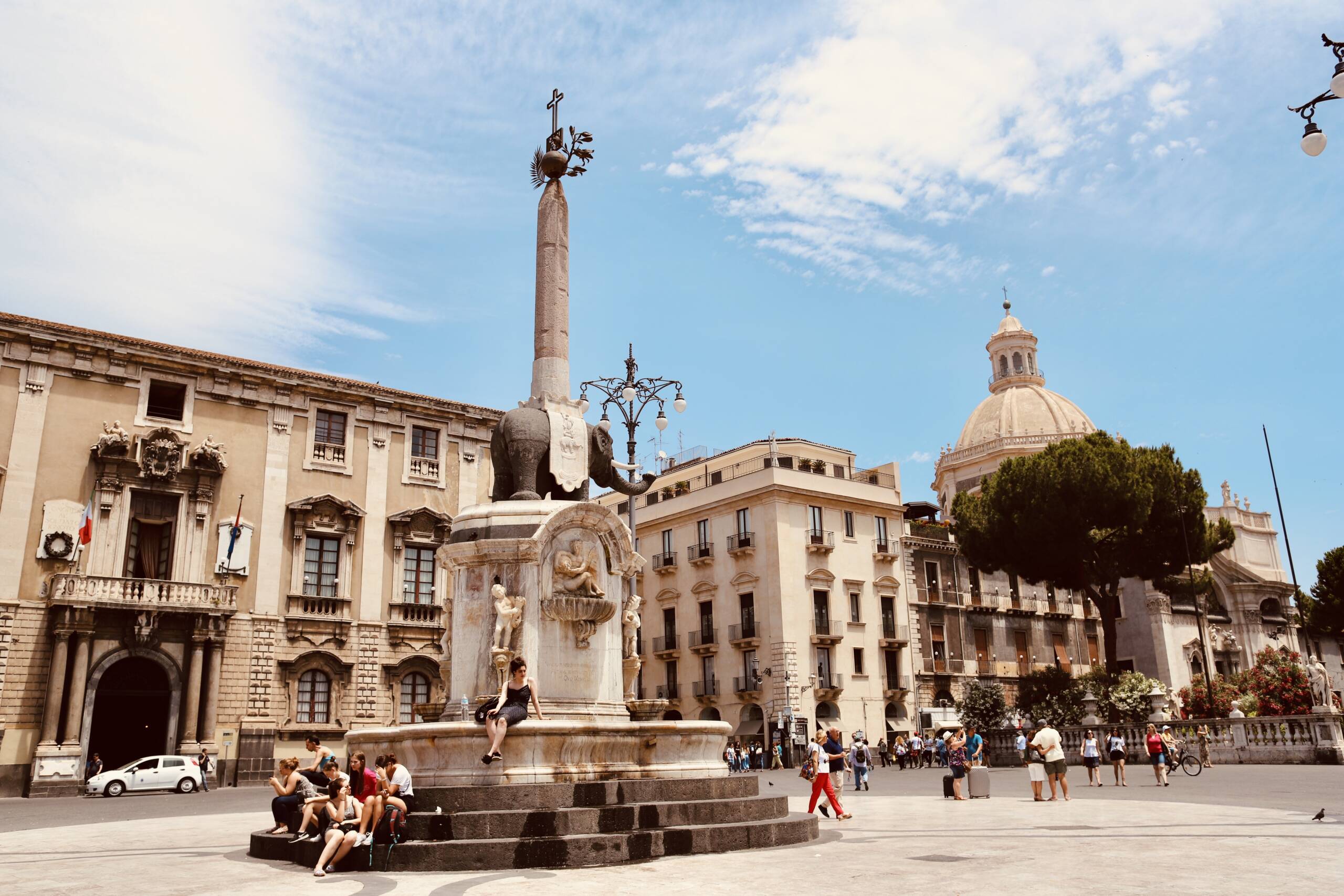
The elephant and the volcano
Everything here is built of lava. Mount Etna, 30 kilometres away, has buried Catania more than once, and the city rebuilt each time with the stone it left behind. You see it everywhere: dark grey paving, black window frames, black pilasters on pale facades. The elephant is the city's emblem, its good-luck charm against the mountain.
The square's other side is the cathedral of Sant'Agata, the city's patron. She was a young Christian woman martyred in Catania in the third century, and Catanians believe she has turned the lava back from their walls.
The Sant'Agata festival
Every February, Catania holds one of the biggest religious festivals in the world. The main days are 3, 4 and 5 February: an offering of wax on the 3rd, a pre-dawn mass and a huge procession on the 4th, and the solemnity on the 5th, when the saint's silver reliquary is pulled through the streets by thousands of devotees in white robes, through the night and into the next morning. Celebrations run for about two weeks around those days.
It's an extraordinary thing to see and a tough one to be part of. Crowds are enormous and the streets pack tight. Book a room early.
The fish market
Walk to the back of the square past the Amenano fountain, its water spilling over the edge like a sheet, and you're in La Pescheria, Catania's fish market. It runs Monday to Saturday from about 7:00 until early afternoon and closes on Sundays. Go before noon, when most stalls are still busy. Swordfish heads point at the sky, men shout prices, and the floor is wet with ice and sea water.
The trattorias on the edge of the market cook what's on the stalls. Order whatever is fresh, with pasta alla Norma to follow, Catania's own dish of aubergine, tomato and salted ricotta.
More on the square: Piazza del Duomo, Catania: Where a Black Lava Elephant Guards Sicily's Baroque Heart on Travel Marketing.