Bruges Burg Square: City Hall, the Holy Blood and the Visitor Fees on the Way
Most day-trippers to Bruges spend their time in the Markt, the big square under the belfry. The Burg is two minutes away and better. It's smaller, it's older, and it's where Bruges was actually governed for six hundred years.
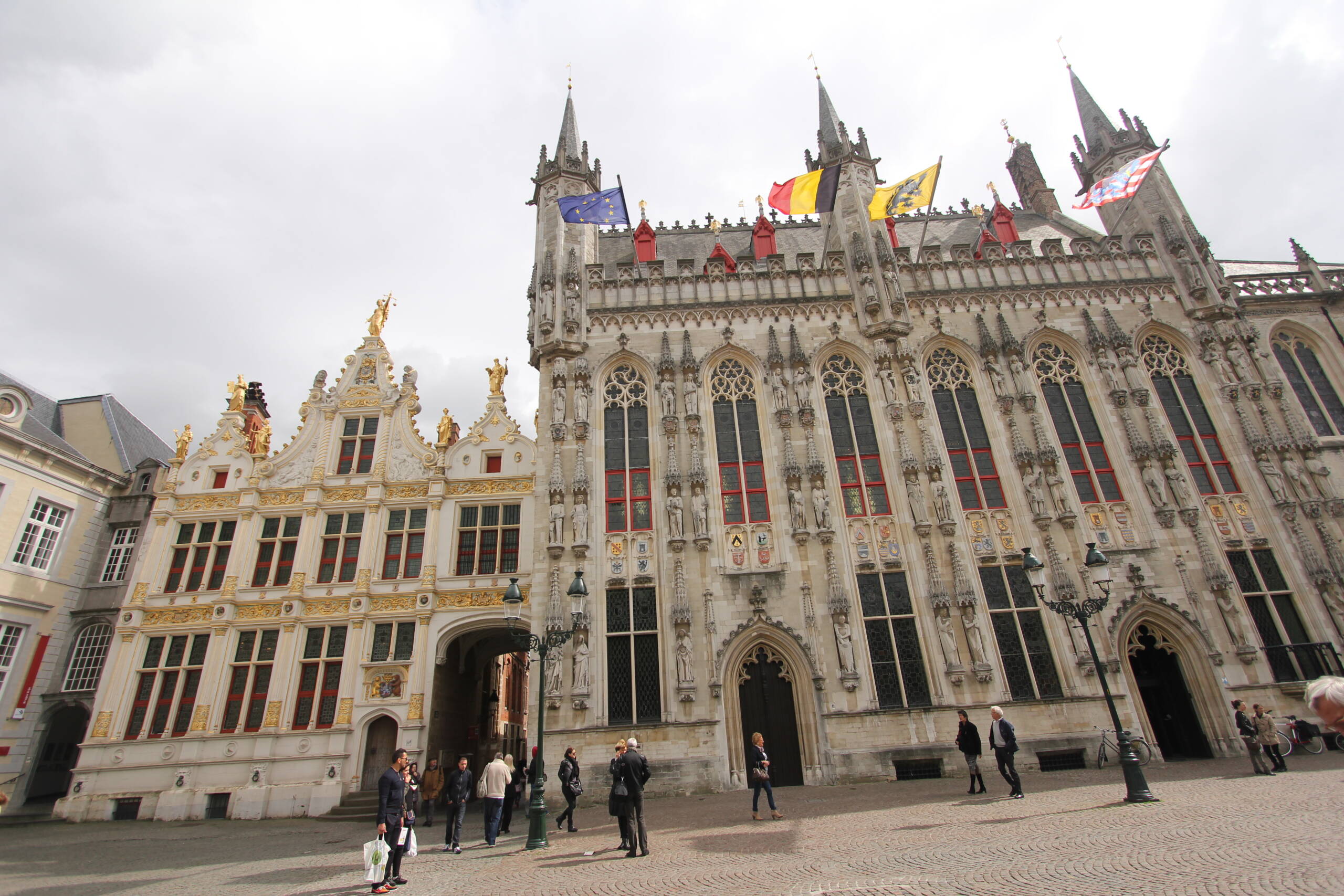
Its centrepiece is the City Hall, built between 1376 and 1421 and one of the oldest in the Low Countries. Its facade is a stone lace of pointed windows, turrets and niches full of statues of the counts and countesses of Flanders. Next to it, gilded and busy, stands the old Civil Registry, a Renaissance building from the 16th century that looks like it was dipped in gold leaf.
The photo below takes both in on a grey day, flags on the roofline, a scatter of visitors crossing the cobbles. It's quieter than it looks in summer. The groups move through fast and head for the canals.
What to see on the Burg
The Gothic Hall. Upstairs in the City Hall, its 19th-century murals tell Bruges's history and its carved wooden vault hangs over a room still used for city weddings. The ticket is cheap and the room takes ten minutes. It's one of the best rooms in Belgium.
The Basilica of the Holy Blood. In the corner of the square, a dark Romanesque lower chapel with a much more ornate chapel above. The upper chapel keeps a relic said to hold drops of Christ's blood, brought from the Holy Land in the Middle Ages and shown to the faithful daily. Every year on Ascension Day the city walks it through the streets in the Procession of the Holy Blood.
The Liberty of Bruges. The palace on the far side of the square housed the court of the surrounding countryside. Its museum is known for one thing above all, a huge carved Renaissance chimneypiece in wood, marble and alabaster.
Walk through the arch under the Civil Registry, Blinde Ezelstraat, and you come out onto a canal and the fish market. That's the exit most people miss.
The fees coming to Bruges
Bruges takes its visitor pressure seriously, and the city has set out new charges. From 1 January 2027, cruise passengers docking at Zeebrugge and visiting the city will pay €5 each. From 1 January 2028, the same €5 applies to day visitors coming in coach groups, and the overnight tourist tax rises from €3.75 to €5 per person per night.
There's no flat fee on independent day-trippers, and the mayor has ruled one out. If you come by train on your own, Bruges stays free to enter. Come midweek and you'll also come at a quieter time.
Making the day work
Arrive early and stay late. Most groups get to Bruges between ten and eleven and leave by four. Before and after those hours the Burg and the canals are calm. Better still, sleep one night. Bruges at 9pm, lit and nearly empty, is a different town from Bruges at noon.
For a full day in the city: Making the Most of a Day Trip to Bruges, Belgium and Burg Square, Bruges: Where the City Was Actually Run on Travel Marketing.