Antwerp Grote Markt: Brabo, the Giant's Severed Hand and a Renaissance City Hall
In the middle of Antwerp's main square a bronze hero stands on a pile of rocks and throws a severed hand. Water pours from the wrist. Tourists climb the rocks for photos. That's the Brabo Fountain, and it tells you, in one gesture, the story Antwerp likes to tell about its own name.
The legend goes like this. A giant called Druon Antigoon held the river Scheldt and made every passing boat pay a toll. Sailors who couldn't pay lost a hand. A young Roman soldier, Silvius Brabo, killed the giant, cut off his hand and threw it into the river. Hand werpen, "hand throwing," became Antwerpen. Linguists say the name more likely comes from "aan de werpen," land built up along the river. Nobody in the square cares.
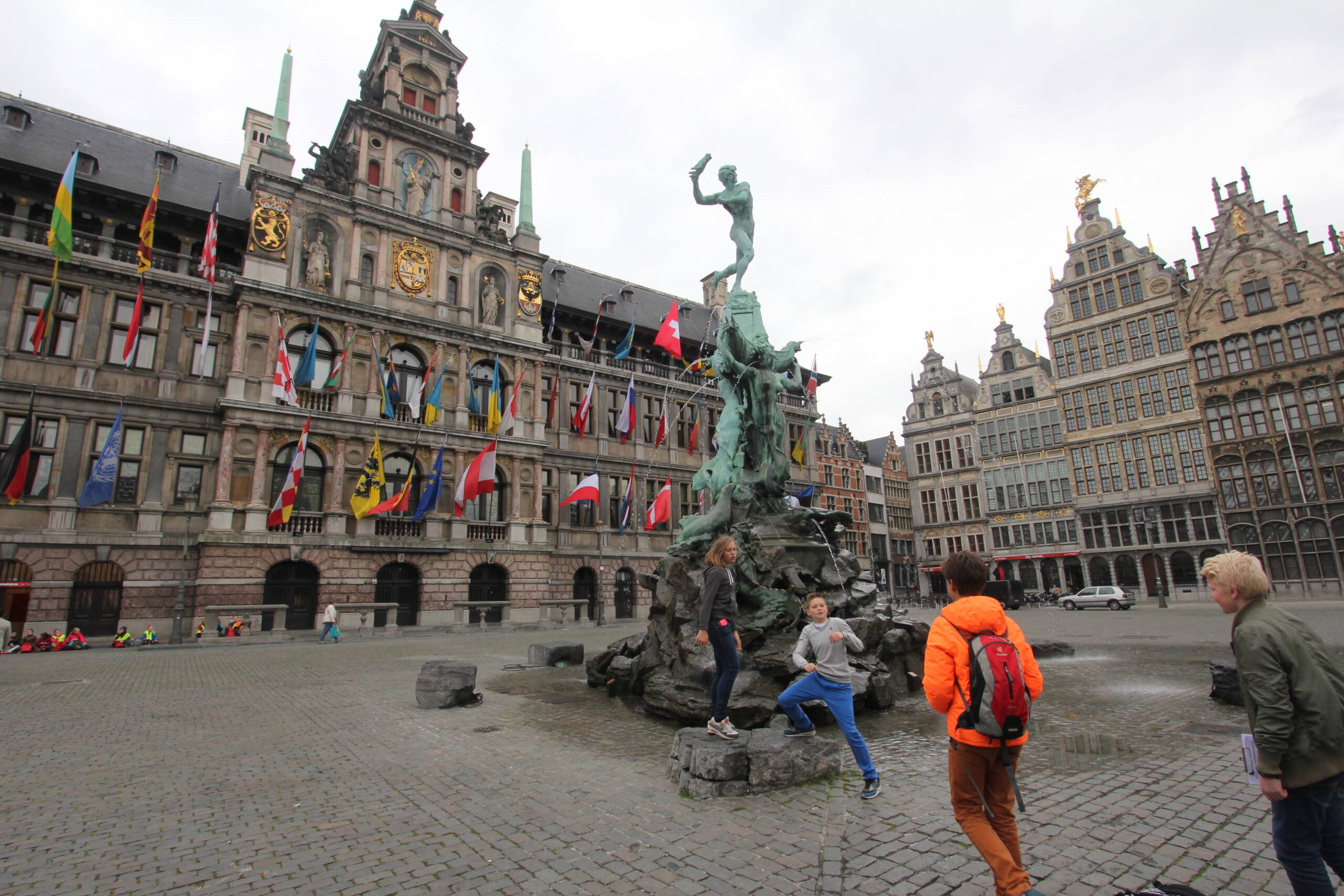
The photo below takes in the scene on a cloudy day: the fountain in the foreground with visitors clambering around its base, a hiker in an orange jacket striding past, and behind it the long facade of the City Hall hung with flags, with the stepped gables of the old guild houses running off to the right.
The fountain
The Brabo Fountain is the work of the Antwerp sculptor Jef Lambeaux, unveiled on 21 August 1887. It's a big, theatrical thing in the taste of its age: Brabo at the top in mid-throw, the defeated giant beneath him, sea creatures and mermaids around the rocky base.
Antwerp sells chocolate hands and hand-shaped biscuits all over the old town in its honour. Buy a box. It's the only souvenir that tells a story.
The City Hall
Behind the fountain, the City Hall was built between 1561 and 1565 by Cornelis Floris de Vriendt, at the height of Antwerp's Golden Age, when it was the busiest port and richest trading city in northern Europe. The design mixes Flemish and Italian Renaissance ideas: a long, horizontal front with classical columns and a tall, ornate central bay that rises above the roofline like a showpiece.
It burned in 1576 during the Spanish Fury, when unpaid Spanish troops sacked the city, and was rebuilt soon after. Today it's part of the UNESCO World Heritage listing for the belfries of Belgium and France.
The guild houses
Around the square, the tall, narrow guild houses carry gilded figures on their gables. Many were heavily restored in the 19th and 20th centuries, which is why they look so crisp. They house bars and restaurants now, with terraces spilling onto the square.
When to come
Morning, before the tour groups, if you want the square to yourself. Evening if you want it lively, when the terraces fill and the City Hall is lit. From here the cathedral is two minutes away down a side street, and the river and the Steen castle another five.
More on the square and its life: Antwerp's Grote Markt: A Living Stage of Legend, Trade, and Daily Life on Travel Marketing.