Florence Cathedral and Brunelleschi’s Dome: A Closer Look at the City’s Marble Landmark
Florence Cathedral is one of those buildings that seems familiar long before you arrive. Its dome appears in books, photographs and paintings, and the façade’s patterned marble has become almost shorthand for the city itself. Standing in Piazza del Duomo, though, the scale and the amount of detail are harder to take in than any picture suggests. The cathedral is not a single architectural statement made at one moment. It is a long record of ambition, changing taste and engineering problems that took generations to solve.
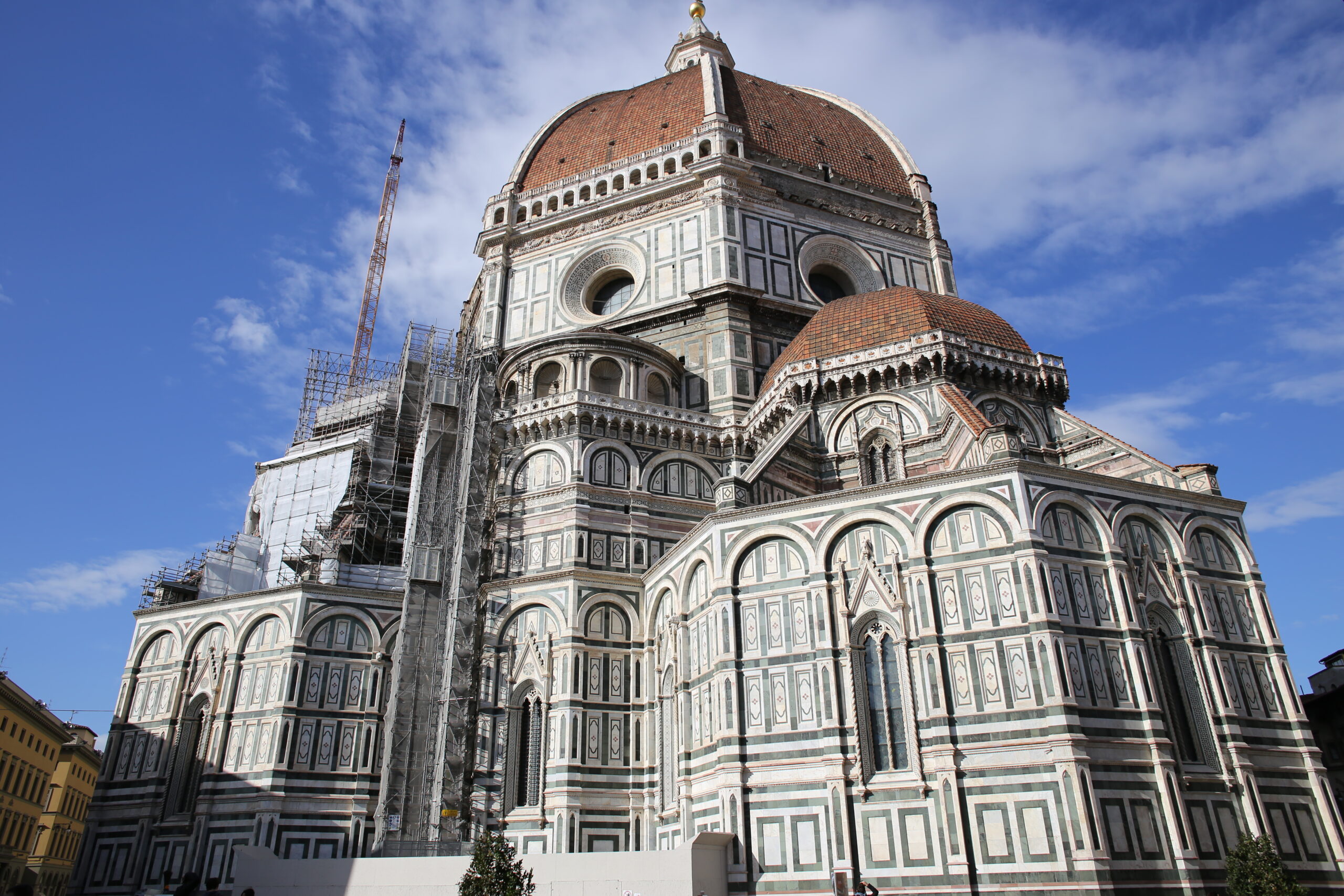
The exterior is immediately striking. White, green and pink marble form geometric panels across the façade, with pointed gables, carved details and rows of niches giving the surface an almost textile-like complexity. The cathedral’s immense body occupies the square, while Giotto’s Campanile rises beside it as a separate vertical landmark. Behind the church, Brunelleschi’s dome dominates the skyline. Its warm terracotta roof looks surprisingly simple from a distance, but the structure beneath it was an extraordinary answer to a problem that had challenged builders for decades.
The dome that changed architecture
The cathedral, formally the Cattedrale di Santa Maria del Fiore, was begun in 1296. Work continued through the fourteenth century, but the enormous opening above the crossing remained unresolved. Filippo Brunelleschi’s winning design led to construction of the dome from 1420. Rather than relying on the conventional timber centering that would have been difficult to build at such a scale, the project used an ingenious arrangement of masonry, rings and interlocking construction techniques. The result became one of the defining achievements of Renaissance engineering.
Look carefully at the dome from different points around the square. The double-shell structure, the ribs and the lantern at its crown give it a profile that is both monumental and carefully controlled. The exterior is covered in terracotta tiles, which create the warm contrast against the pale marble of the cathedral below. It is easy to focus on the dome and overlook the rest of the complex, but the cathedral, bell tower and Baptistery belong to a larger urban composition. Give yourself time to walk around rather than taking everything in from the main entrance.
Seeing the cathedral as a visitor
The cathedral stands in the centre of Florence, a short walk from the main railway station and within the compact historic centre. Piazza del Duomo is busy for much of the day, particularly in the middle of the tourist season. Early morning is usually the most comfortable time to appreciate the exterior and photograph the façade before the square fills. Late afternoon can bring softer light across the marble, although the best angle changes as the sun moves.
Entry to the cathedral itself is generally free, but access is subject to church opening hours and religious services. The dome climb, Giotto’s Bell Tower, the Baptistery and the museum are separate paid attractions covered by the monument ticket options. These arrangements, opening hours and access rules can change, so check the official Opera di Santa Maria del Fiore information before setting out and reserve a timed ticket for the dome if climbing it is part of your plan. The climb is demanding, with a long sequence of stairs and narrow passages; it is not suitable for everyone, and there is no ordinary lift to the top.
Even without climbing, the square rewards a slow visit. The cathedral’s interior is much more restrained than its exterior, which makes the contrast worth seeing. The nearby Museo dell’Opera del Duomo adds context to the sculptures and architectural elements that once formed part of the complex. If you have time, consider visiting it rather than treating the piazza as a quick photo stop.
Florence has no shortage of celebrated buildings, but the cathedral remains its most commanding public landmark. The marble façade catches the eye first; the dome explains why the building became an architectural turning point. Stand back, walk around it, and look up more than once. The details reveal themselves gradually, and that is part of the pleasure.