Folk Dances in Bergerac: When Visitors Join the Celebration
In Bergerac, a courtyard of old stone buildings can become a dance floor without losing any of its character. A group of dancers in traditional dress takes the space between the weathered masonry and the townhouses, while musicians play from chairs set against the wall. The occasion feels close to the people watching it. There is no elevated stage to separate performers from the audience, and the most interesting part comes when tourists are encouraged to join the dancing rather than remain spectators.
The photograph catches the gathering in full movement. Women wear white bonnets and blouses, colourful shawls, and broad striped or checked skirts that swing outward as they turn. The men have dark blue smocks, black hats and neckwear, their hands resting on their hips between steps. At the left, musicians sit with their instruments, including an accordion, beside a small microphone and speaker. Strings of outdoor lights cross the pale, patched stone wall; behind the dancers are steep tiled roofs, shuttered windows, greenery and a small statue almost hidden by the trees. The irregular brick paving and warm, worn buildings make the scene unmistakably part of an old French town.
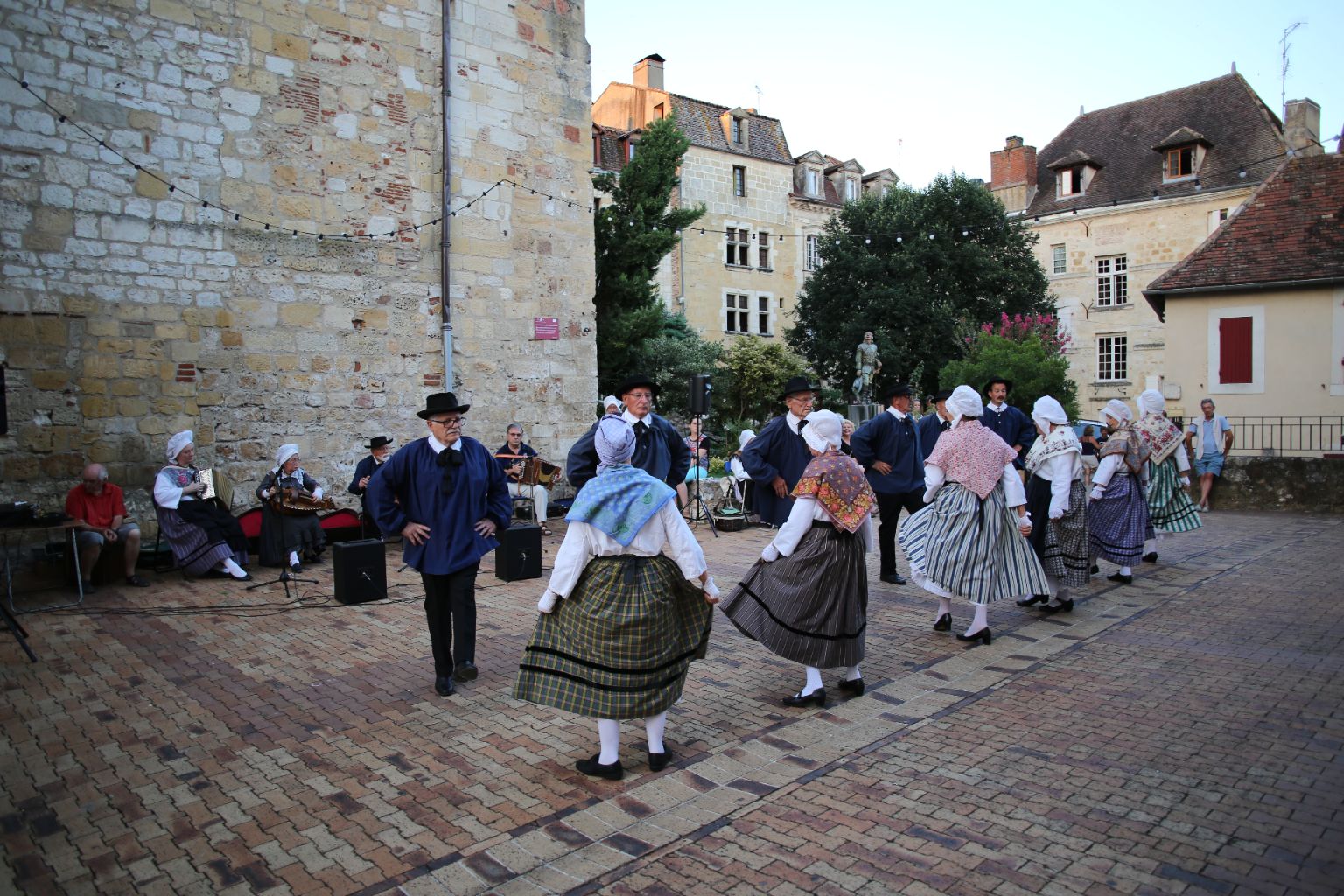
Photograph hosted by TravelMktg.com.
The costumes give the dancing its visual appeal, but the chance to take part gives the event its social energy. Visitors who have come to see a performance can find themselves learning the next movement, watching the feet of more experienced dancers and trying to keep up with a turning group. There may be a missed step or a hesitant turn. That is part of the pleasure. A traditional dance works differently when the audience is allowed inside it: the distance between a town and its guests becomes smaller almost at once.
Bergerac, on the Dordogne River in southwestern France, is known for its historic streets, wine country and the old architectural fabric of the Périgord. Its wider region also has a lively calendar of music and dance. These occasions offer another way to appreciate the place, especially after a day spent walking past old houses, visiting the riverside and exploring the centre. A folk performance in a courtyard draws attention to something that is easy to miss on a sightseeing route: heritage is carried by people, as well as preserved in walls and monuments.
For travellers, the useful advice is to look beyond the headline attractions and check the local events calendar while planning a visit. The Bergerac tourism office and the Dordogne-Périgord tourism listings are good starting points for seasonal concerts, festivals and community celebrations. Events vary by date, and the photograph alone does not establish the name or recurring schedule of this particular gathering. If an outdoor folk-dance performance is underway, stay a while. Watch how the group moves, and join in when an invitation is offered. You do not need to arrive knowing the steps.
There is a small courtesy to remember, too. The musicians and costumed dancers are sharing a local tradition, not staging a private photo session. Leave room for the movement, avoid walking through the musicians' space, and be considerate when photographing people who have come to enjoy the evening. For families and visiting couples, simply standing nearby and watching the dancers change partners can be enjoyable enough. For anyone willing to try a few steps, the experience becomes something more personal.
The photograph captures why these small public gatherings matter. The setting is handsome, certainly, but the cobbles and limestone are only the background. What makes the scene memorable is the exchange between musicians, dancers and visitors, a piece of local culture that people can encounter together. Bergerac has plenty to offer from a postcard. On an evening like this, it also offers the pleasure of stepping into the picture.