Big Buddha Temple on Koh Samui: The Naga Staircase, the Dress Code and When to Go
You see the Big Buddha before you land. The statue sits on a small islet on the northeast coast of Koh Samui, a few kilometres from the airport, and planes coming in over the sea pass close enough to see the gold catch the sun.
Wat Phra Yai, the Temple of the Big Buddha, was built in 1972. The statue is about 12 metres tall, seated in the pose of Buddha subduing Mara, the demon of temptation: right hand resting on the knee, fingers touching the ground to call the earth as witness. It sits on Koh Faan, a tiny island joined to Samui by a causeway, facing out over the water.
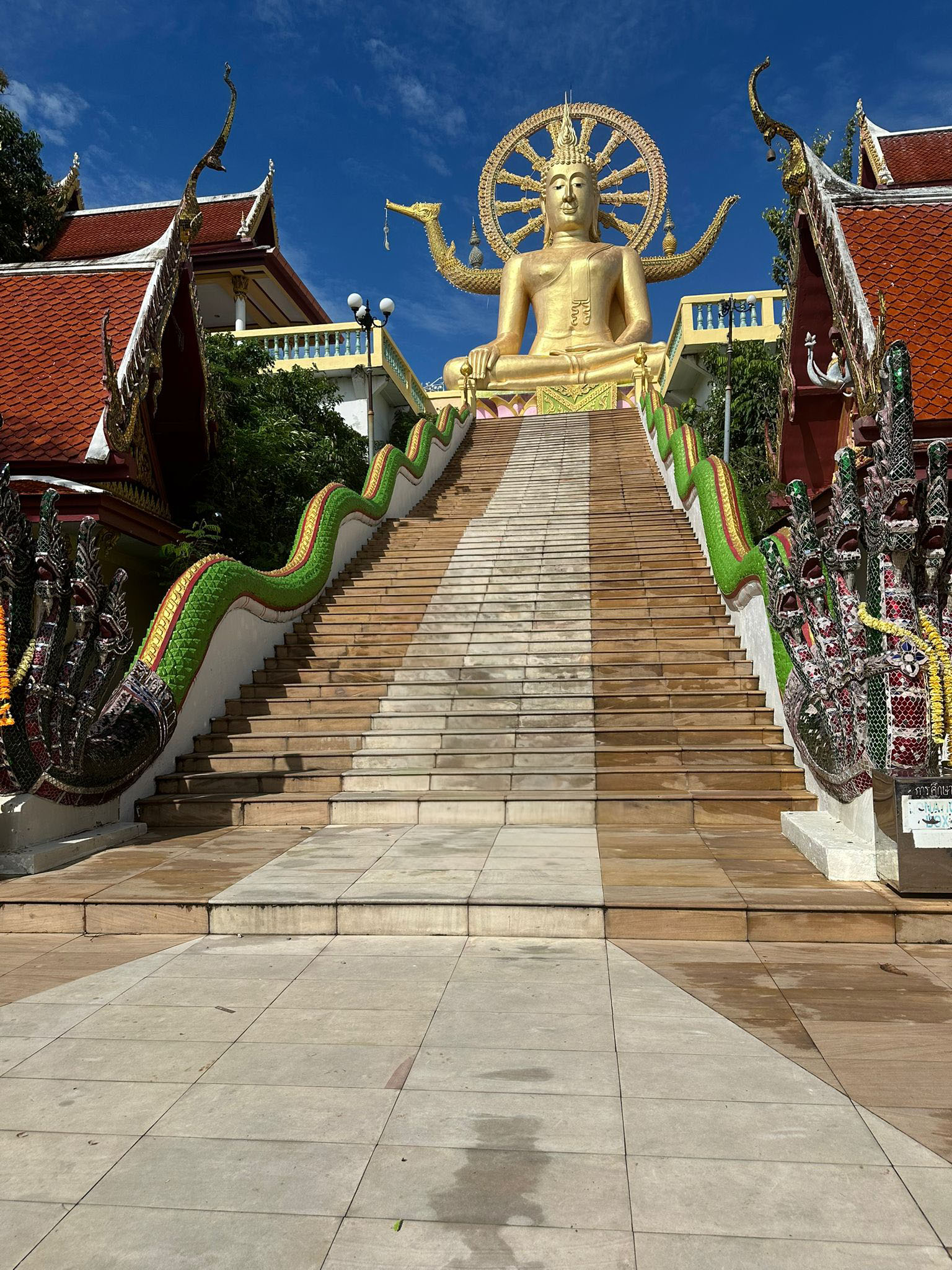
The photo below climbs with you. A long stone staircase rises between two great serpent bodies, the nagas, their scaled backs forming the banisters in green and gold. At the top, under a blue sky, the gold Buddha sits framed between temple roofs in red and white.
Visiting
Entry is free, though donations are welcome. Cover your shoulders and knees. If you arrive in beachwear, sarongs and cover-ups are lent free at the entrance. Take off your shoes before you climb the final steps to the platform around the statue, and don't point your feet at the Buddha when you sit.
Go early. By mid-morning the stone at the top is hot enough to hurt bare feet, and the tour vans arrive. At 8am the light is soft and the steps are nearly empty.
Sunset works too, when the gold turns orange and the sea behind it goes pink.
At the foot of the steps, a row of stalls sells snacks, sarongs, souvenirs and offerings: lotus buds, incense and flowers.
Nearby
Wat Plai Laem, a few minutes' drive west, is the Big Buddha's flamboyant neighbour. It sits on a lake, with a huge white statue of Guanyin, the Chinese goddess of mercy, with 18 arms, and a laughing fat Buddha beside her. Feed the catfish in the lake for a few baht.
Bophut's Fisherman's Village, about ten minutes away, has old wooden shophouses turned restaurants and bars along the beach, and a walking street market on Friday evenings.
Getting there is easy: a short taxi or songthaew ride from Chaweng or Bophut, or ten minutes from the airport. If you've got a long layover or an evening flight, the temple fits neatly into the last morning of a trip.
The weather matters. On this side of Thailand, October to December is the wettest time of year, with heavy rain and grey skies. The dry months, roughly February to August, give the best chance of blue sky behind the gold.
More on the island: Koh Samui, Thailand: Where the Sky Meets the Sea in Shades of Dream on Travel Marketing.